



Description
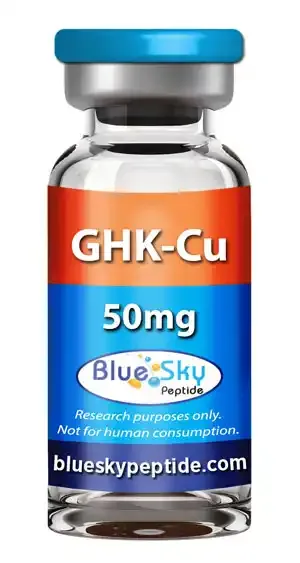
GHK-Cu 50mg Copper Peptide :
| Unit Size | 50mg/vial |
| Unit Quantity | 1 vial |
| Purity (Mass Spectrometry and UV) | 99.96% |
| Sequence | Gly-His-Lys.Cu.xHAc |
| Molecular Formula | C14H23CuN6O4 |
| Appearance | Lyophilized Powder |
| Source | Chemical Synthesis |
| Storage | Lyophilized GHK-Cu 50mg Copper Peptide is stable at room Temperature for 90 days, however it is best to store in a freeze below – 8c for any extended period of time. |
| Terms | The products we offer are intended for laboratory research use only. Please familiarize yourself with our terms of service prior to ordering. |
GHK-Cu 50mg Copper Peptide
View Research Overview & References
GHK-Cu, or Glycyl-L-Histidyl-L-Lysine Copper(II), is a synthetic copper peptide created by chelating the GHK peptide with copper ions. GHK-Cu has been studied in in vitro and in vivo (animal) laboratory research for its effects on cell signaling pathways related to tissue remodeling, angiogenesis-related cell activity, and inflammatory signaling. This product is strictly for in vitro and in vivo (animal) laboratory research and is not approved for human or veterinary use.
Cell Signaling and Growth Factor Research
Laboratory studies have examined GHK-Cu’s effects on the expression of growth factors including basic fibroblast growth factor (bFGF) and vascular endothelial growth factor (VEGF) in cell culture models, particularly at concentrations around 1 nM.2-4 These growth factors are studied for their role in angiogenesis-related signaling pathways. Laboratory research has also examined GHK-Cu’s effects on endothelial cell proliferation markers.5 Additional in vitro and animal model research has examined GHK-Cu’s effects on capillary cell recruitment, macrophage and mast cell activation markers, and collagen and elastin production in cultured and animal model systems.6-8
Bone Cell Research
In vitro and animal model studies have examined GHK-Cu’s effects on collagen synthesis markers and osteoblast attachment in bone cell models.9,10 Separate animal model research, including a rat model related to ligament tissue research, has examined markers of tissue repair signaling following GHK-Cu application.5,11
Inflammatory Signaling and Oxidative Stress Research
Laboratory studies have examined GHK’s effects on lipid peroxidation markers and reactive oxygen species (ROS) levels across various cultured cell types.12 In animal models involving induced lung tissue changes, research has examined GHK and GHK-Cu’s effects on inflammatory signaling markers such as TNF-α and IL-6.13 Mechanistic studies have also examined GHK-Cu’s effects on NF-κB p65 and p38 MAPK signaling pathways, which are involved in regulating inflammatory signaling.13
Aging Animal Model Research
Research in aging mice has examined GHK administration in relation to spatial navigation task performance. Brain tissue analysis in these models showed changes in inflammatory markers and histone deacetylase 2 labeling, which researchers noted may reflect epigenetic signaling pathways under investigation.14
Important Notice
The findings presented are based on in vitro and in vivo (animal) laboratory research. This GHK-Cu product is strictly intended for in vitro and in vivo (animal) laboratory research only and is not suitable for human, veterinary, or therapeutic use. Any use outside of controlled laboratory settings is prohibited, and these findings do not establish safety, efficacy, or suitability for any human or animal application.
References
1. Pickart L. The human tri-peptide GHK and tissue remodeling. J Biomater Sci Polym Ed. 2008;19(8):969-988.
2. Pollard JD, Quan S, Kang T, Koch RJ. Effects of copper tripeptide on the growth and expression of growth factors by normal and irradiated fibroblasts. Arch Facial Plast Surg. 2005;7(1):27-31.
3. Steiling H, Werner S. Fibroblast growth factors: key players in epithelial morphogenesis, repair, and cytoprotection. Curr Opin Biotechnol. 2003;14(5):533-537.
4. Powers CJ, McLeskey SW, Wellstein A. Fibroblast growth factors, their receptors, and signaling. Endocr Relat Cancer. 2000;7(3):165-197.
5. Wang X, Liu B, Xu Q, et al. GHK-Cu-liposomes accelerate scald wound healing in mice by promoting cell proliferation and angiogenesis. Wound Repair Regen. 2017;25(2):270-278.
6. Raju KS, Alessandri G, Gullino PM. Characterization of a chemoattractant for endothelium induced by angiogenesis effectors. Cancer Res. 1984;44(4):1579-1584.
7. Poole TJ, Zetter BR. Stimulation of rat peritoneal mast cell migration by tumor-derived peptides. Cancer Res. 1983;43(12 Pt 1):5857-5861.
8. Maquart FX, Bellon G, Chaqour B, et al. In vivo stimulation of connective tissue accumulation by the tripeptide-copper complex glycyl-L-histidyl-L-lysine-Cu2+ in rat experimental wounds. J Clin Invest. 1993;92(5):2368-2376.
9. Pohunková H, Stehlík J, Váchal J, Cech O, Adam M. Morphological features of bone healing under the effect of collagen-graft-glycosaminoglycan copolymer supplemented with the tripeptide Gly-His-Lys. Biomaterials. 1996;17(16):1567-1574.
10. Godet D, Marie PJ. Effects of the tripeptide glycyl-L-histidyl-L-lysine copper complex on osteoblastic cell spreading, attachment, and phenotype. Cell Mol Biol (Noisy-le-grand). 1995;41(8):1081-1091.
11. Fu SC, Cheuk YC, Chiu WY, Yung SH, Rolf CG, Chan KM. Tripeptide-copper complex GHK-Cu (II) transiently improved healing outcome in a rat model of ACL reconstruction. J Orthop Res. 2015;33(7):1024-1033.
12. Sakuma S, Ishimura M, Yuba Y, Itoh Y, Fujimoto Y. The peptide glycyl-L-histidyl-L-lysine is an endogenous antioxidant in living organisms, possibly by diminishing hydroxyl and peroxyl radicals. Int J Physiol Pathophysiol Pharmacol. 2018;10(3):132-138.
13. Zhou XM, Wang GL, Wang XB, et al. GHK Peptide Inhibits Bleomycin-Induced Pulmonary Fibrosis in Mice by Suppressing TGFβ1/Smad-Mediated Epithelial-to-Mesenchymal Transition. Front Pharmacol. 2017;8:904.
14. Dou Y, Lee A, Zhu L, Morton J, Ladiges W. The potential of GHK as an anti-aging peptide. Aging Pathobiol Ther. 2020;2(1):58-61.