



Description
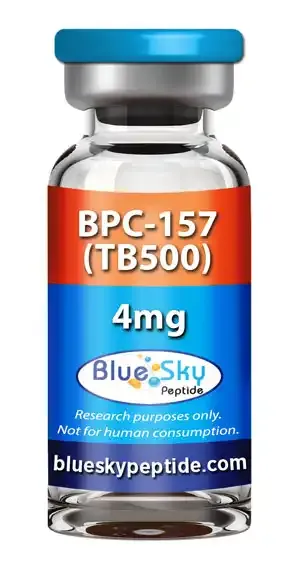
Buy Blend BPC-157 2mg with Thymosin Beta 4 (TB500) 2mg:
| Unit Size | 4 mg/vial |
| Unit Quantity | 1 vial |
| Purity (Mass Spectrometry and UV) | 99.89% Nominal Target: 2 mg BPC-157 + 2 mg Thymosin Beta 4 (TB500) |
| Sequence (BPC-157) | H-Gly-Glu-Pro-Pro-Pro-Gly-Lys-Pro-Ala-Asp-Asp-Ala-Gly-Leu-Val-OH |
| Sequence (TB500) | Ac-Ser-Asp-Lys-Pro-Asp-Met-Ala-Glu-Ile-Glu-Lys-Phe-Asp-Lys-Ser-Lys-Leu-Lys-Lys-Thr-Glu-Thr-Gln-Glu-Lys-Asn-Pro-Leu-Pro-Ser-Lys-Glu-Thr-Ile-Glu-Gln-Glu-Lys- Gln-Ala-Gly-Glu-Ser-OH |
| Molecular Formula (BPC-157) | C62H98N16O78 |
| Molecular Formula (TB500) | C212H350N56O22 S |
| Appearance | Lyophilized White Powder |
| Source | Chemical Synthesis |
| Storage | Lyophilized Blend BPC-157 2MG with Thymosin Beta 4 (TB500) 2MG is stable at roomTemperature for 90 days, however it is best to store in a freezer below – 8c for any extended period of time. . |
| Terms | The products we offer are intended for laboratory research use only. Please familiarize yourself with our terms of service prior to ordering. |
Blend BPC-157 2mg with Thymosin Beta 4 (TB500) 2mg
View Research Overview & References
This blend combines two synthetic peptides, BPC-157 and Thymosin Beta 4, formulated specifically for in vitro and in vivo (animal) laboratory research. These peptides are strictly intended for research purposes only and are not approved for human or animal consumption.
Animal and Cell Model Research
Animal studies on BPC-157 and Thymosin Beta 4 have examined their roles in cell signaling relevant to:
- Wound tissue models1,2
- Muscle and tendon tissue models3,4
- Vascular cell signaling1,5
- Gastrointestinal tissue models6,7
These studies are preliminary laboratory findings and do not establish clinical safety or efficacy.
BPC-157 Mechanism Research
BPC-157 has been studied in laboratory settings for its association with several signaling markers, including nitric oxide signaling markers, cell migration and proliferation markers, growth factor-related signaling, and inflammatory marker levels.8 These properties make BPC-157 a subject of interest for in vitro and in vivo research on tissue-level cell behavior.
Thymosin Beta 4 Mechanism Research
Thymosin Beta 4 binds to actin, a protein involved in cellular movement, and is studied for its role in the migration and differentiation of stem and progenitor cells. Its association with blood vessel formation markers makes it a subject of interest in cell biology research.9
Important Notice
This peptide blend is provided strictly for in vitro and in vivo (animal) laboratory research and is not suitable for clinical, veterinary, or personal use. Application or ingestion outside of controlled research settings is prohibited, and this product has not been evaluated for safety or efficacy in humans or animals.
Product Information
The blend is supplied as a white lyophilized powder, with each vial containing a total of 10 mg (2 mg of each peptide).
References
1. Huang T et al. Body protective compound-157 enhances alkali-burn wound healing in vivo and promotes proliferation, migration, and angiogenesis in vitro. Drug Des Devel Ther. 2015;9:2485-99.
2. Philp D, Kleinman HK. Animal studies with thymosin beta, a multifunctional tissue repair and regeneration peptide. Ann N Y Acad Sci. 2010;1194:81-6.
3. Seiwerth S et al. BPC 157 and standard angiogenic growth factors. Gastrointestinal tract healing, lessons from tendon, ligament, muscle, and bone healing. Curr Pharm Des. 2018;24(18):1972-1989.
4. Xu B et al. Thymosin β4 enhances the healing of medial collateral ligament injury in rat. Regul Pept. 2013;184:1-5.
5. Smart N et al. Thymosin beta4 induces adult epicardial progenitor mobilization and neovascularization. Nature. 2007;445(7124):177-82.
6. Vukojević J et al. Rat inferior caval vein ligature and new insights with the stable gastric pentadecapeptide BPC 157. Vascul Pharmacol. 2018;106:54-66.
7. Nemolato S et al. Thymosin beta 4 immunoreactivity in fetal and adult gastrointestinal tracts. PLoS One. 2010;5(2):e9111.
8. Chang CH et al. BPC 157 enhances growth hormone receptor expression in tendon fibroblasts. Molecules. 2014;19(11):19066-77.
9. Goldstein AL et al. Thymosin β4: a multifunctional regenerative peptide. Expert Opin Biol Ther. 2012;12(1):37-51.