



Description
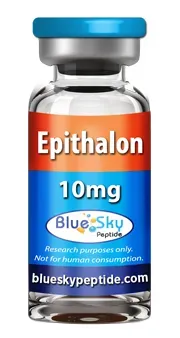
Buy Epithalon 10mg:
| Unit Size | 10 mg/ vial |
| Unit Quantity | 1 vial |
| Purity (Mass Spectrometry and UV) | 97.60% |
| Sequence | H-Ala-Glu-Asp-Gly-OH |
| Molecular Formula | C14H22N4O9 |
| Appearance | lyophilized White Powder |
| Source | Chemical Synthesis |
| Storage | Epithalon 10mg is stable at room Temperature for 90 days, however it is best to store in a freezer below – 8c for any extended period of time. |
| Terms | The products we offer are intended for laboratory research use only. Please familiarize yourself with our terms of service prior to ordering. |
Epithalon Peptide 10mg
View Research Overview & References
Epithalon peptide is a synthetic peptide that mimics the naturally occurring protein epithalamin. Comprising four amino acids—alanine, glutamic acid, asparagine, and glycine—Epithalon (also known as epitalon) has a molecular mass of 390 g/mol. Research indicates this class of peptide is associated with the pineal gland’s role in regulating circadian rhythms and melatonin secretion.1
Biological Research Findings
Research on Epithalon in animal models has examined several biological pathways, including:
- Melatonin production markers in response to light-dark signals.
- Markers of oxidative stress and inflammatory signaling.
- Immune-related signaling markers.
- Telomerase activity and cellular senescence pathways.
Known as the AEDG peptide (named after its constituent amino acids), Epithalon has been investigated in laboratory research for its ability to upregulate telomerase activity, a topic of interest in cellular biology research.2
Cellular Senescence Research
In vitro studies have examined Epithalon’s effects on human fibroblast cell lines, with one study reporting that Epithalon-treated cells underwent a greater number of population doublings (over 44 passages) before reaching the Hayflick limit (the point at which cells enter senescence), compared to 34 passages for control cells.3 Separately, in vivo studies in mouse models examined chromosomal abnormality markers in both wild-type and accelerated-aging mice following Epithalon administration.4
In vivo studies in aging rat models have also examined the activity of antioxidant enzymes, including glutathione-S-transferase, superoxide dismutase, and glutathione peroxidase, following Epithalon administration.5
Product Information
Epithalon is supplied as a lyophilized white powder in 10 mg vials.
Important Notice
This peptide is intended for in vitro and in vivo (animal) laboratory research only. It is not approved for human or veterinary use. These findings do not establish safety, efficacy, or suitability for any human or animal application outside of controlled research.
References
1. Khavinson V, Diomede F, Mironova E, Linkova N, et al. AEGD Peptide (Epitalon) Stimulates Gene Expression and Protein Synthesis during Neurogenesis: Possible Epigenetic Mechanism. Molecules. 2020 Feb;25(3):609.
2. Khavinson V. Peptides and Ageing. Neuro Endocrinol Lett. 2022;23 Suppl 3:11-144.
3. Khavinson VK, Bondarev IE, Butyugov AA. Epithalon peptide induces telomerase activity and telomere elongation in human somatic cells. Bull Exp Biol Med. 2003 Jun;135(6):590-2.
4. Khavinson VK, Bondarev IE, Butyugov AA, Smirnova TD. Peptide promotes overcoming of the division limit in human somatic cells. Bull Exp Biol Med. 2004 May;137(5):503-6.
5. Rosenfeld SV, Togo EF, Mikheev VS, Popovich IG, et al. Effect of epithalon on the incidence of chromosome aberrations in senescence-accelerated mice. Bull Exp Biol Med. 2002 Mar;133(3):274-6.
6. Kozina LS, Arutjunyan AV, Khavinson VK. Antioxidant properties of geroprotective peptides of the pineal gland. Arch Gerontol Geriatr. 2007;44 Suppl 1:213-6.