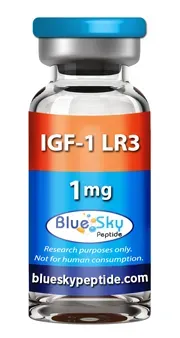




Description
Buy Premium IGF-1 LR3 1mg :
| Unit Size | 1 mg/vial |
| Unit Quantity | 1 vial |
| Purity (Mass Spectrometry & UV) | 99.94% |
| Sequence | MFPAMPLSSL FVNGPRTLCG AELVDALQFV CGDRGFYFNK PTGYGSSSRR APQTGIVDEC CFRSCDLRRL EMYCAPLKPA KSA |
| Molecular Formula | C400H625N111O115S9 |
| Appearance | Lyophilized White Powder |
| Source | Recombinant Synthesis |
| Storage | Lyophilized IGF-1 LR3 is stable at room Temperature for 90 days, however it is best to store in a freezer below – 8c for any extended period of time. |
| Terms | The products we offer are intended for laboratory research use only. Please familiarize yourself with our terms of service prior to ordering. |
IGF-1 LR3 1mg
View Research Overview & References
IGF-1 LR3 is a synthetic peptide developed for in vitro and in vivo (animal) laboratory research. Structurally similar to human insulin-like growth factor 1 (IGF-1), IGF-1 LR3 features specific modifications that enhance its bioavailability and extend its activity for research purposes. This variant has an extended peptide sequence (L) and replaces glutamic acid with arginine at the third position (R3), adding 13 amino acids to the N-terminus for a total of 83 amino acids compared to the 70 amino acids in standard IGF-1.1 These adjustments extend its half-life to 20–30 hours and increase potency by approximately threefold, making it an ideal choice for laboratory studies on cellular and metabolic mechanisms.2,3
The enhanced potency of IGF-1 LR3 results from reduced binding to insulin-like growth factor-binding proteins (IGFBPs), which increases its biological activity in research settings.1,2 Like insulin, IGF-1 LR3 binds to the IGFR1 receptor, promoting cell growth and muscle fiber differentiation in cultured cell lines and other in vitro models.4,5 This peptide is used in laboratory studies to explore IGF-1 receptor interactions, cellular growth mechanisms, and protein synthesis pathways.
IGF-1 LR3 has shown activity across various laboratory research models, with notable applications including:
- Cardiovascular Research Models: In cell cultures, organoid models, and animal studies, IGF-1 LR3 has been used to study cardiomyocyte proliferation and vascular growth, modeling cellular mechanisms relevant to cardiovascular development.6
- Muscle Atrophy Signaling Research: Studies in controlled laboratory environments indicate that IGF-1 LR3 can activate the PI3K/AKT pathway, promoting protein synthesis in cultured cells and offering a mechanistic model for studying pathways involved in muscle atrophy.5
Important Compliance Notice
IGF-1 LR3 is intended strictly for in vitro and in vivo (animal) laboratory research only and is not approved for human, therapeutic, diagnostic, or veterinary use. Any application outside controlled research environments is prohibited. Laboratory safety protocols should be followed when handling this peptide to ensure compliance with research standards.
References
1. Mohan S, Baylink DJ. IGF-binding proteins are multifunctional and act via IGF-dependent and -independent mechanisms. J Endocrinol. 2002 Oct;175(1):19-31.
2. Tomas FM, et al. Insulin-like growth factor-I (IGF-I) and especially IGF-I variants are anabolic in dexamethasone-treated rats. Biochem J. 1992 Feb;282(Pt 1):91-97.
3. von der Thusen J, et al. IGF-1 stabilizes plaques in atherosclerosis by altering vascular smooth muscle cell phenotype. Am J Pathol. 2011 Feb;178(2):924-934.
4. Wrigley S, et al. Insulin-Like Growth Factor 1: At the crossroads of brain development and aging. Front Cell Neurosci. 2017 Feb;11:14.
5. Lovolger S, et al. Inhibition of activin-like kinase ⅘ attenuates cancer cachexia-associated muscle wasting. Sci Rep. 2019;9:9826.
6. Jonker SS, et al. Coronary vascular growth matches IGF-1-stimulated cardiac growth in fetal sheep. FASEB J. 2020 Aug;34(8):10041-10055.