



Description
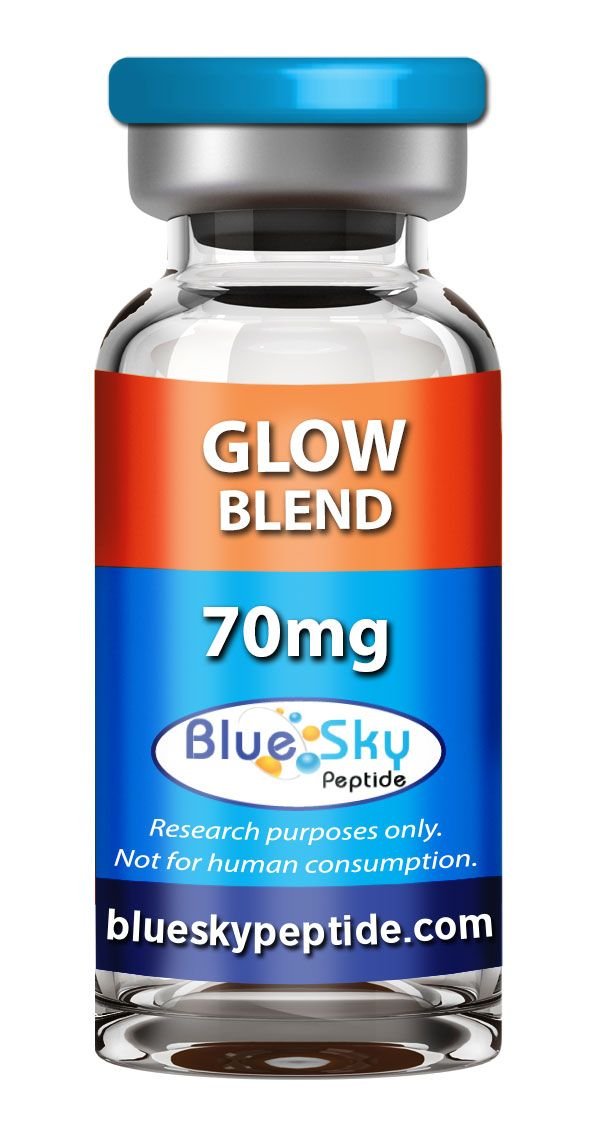
GLOW Blend (GHK-Cu, BPC-157, TB-500) 70mg
| Unit Size | 70 mg/vial |
| Unit Quantity | 1 vial |
| Purity (Mass Spectrometry and UV) | 99.83% Nominal Target: 50 mg GHK-Cu + 10 mg BPC-157 + 10 mg TB-500 |
| Sequence (GHK-Cu) | Gly-His-Lys-Cu |
| Sequence (BPC-157) | H-Gly-Glu-Pro-Pro-Pro-Gly-Lys-Pro-Ala-Asp-Asp-Ala-Gly-Leu-Val-OH |
| Sequence (TB-500) |
Ac-Ser-Asp-Lys-Pro-Asp-Met-Ala-Glu-Ile-Glu-Lys-Phe-Asp-Lys-Ser- Lys-Leu-Lys-Lys-Thr-Glu-Thr-Gln-Glu-Lys-Asn-Pro-Leu-Pro-Ser-Lys- Glu-Thr-Ile-Glu-Gln-Glu-Lys-Gln-Ala-Gly-Glu-Ser-OH |
| Molecular Formula (GHK-Cu) | C14H23CuN6O4 |
| Molecular Formula (BPC-157) | C62H98N16O22 |
| Molecular Formula (TB-500) | C212H350N56O78S |
| Appearance | Lyophilized White Powder |
| Source | Chemical Synthesis |
| Storage | Lyophilized Blend GLOW is stable at room temperature for 90 days, however it is best to store in a freezer below -8°C for any extended period of time. |
| Terms |
The products we offer are intended for laboratory research use only. Please familiarize yourself with our terms of service prior to ordering. |
GLOW Blend 70mg (GHK-Cu / BPC-157 / TB-500)
View Research Overview & References
The GLOW Blend combines three synthetic peptides — GHK-Cu, BPC-157, and Thymosin Beta 4 (TB-500) — into a single lyophilized formulation supplied for in vitro and in vivo (animal) laboratory research. Each component is studied for a distinct signaling mechanism, allowing researchers to examine multiple cellular pathways within a single reagent batch.
GHK-Cu Cell Signaling Research
GHK-Cu, or Glycyl-L-Histidyl-L-Lysine Copper(II), is a copper-binding tripeptide studied for its effects on cultured cell attachment and migration, collagen and glycosaminoglycan production, and gene expression related to oxidative stress, matrix remodeling, and cytokine signaling.1,2
BPC-157 Cell Signaling Research
BPC-157 is a synthetic pentadecapeptide originally derived from a protein found in human gastric juice. It is studied in laboratory research for its interaction with cell signaling pathways related to tissue-level cell behavior, including nitric oxide signaling and endothelial cell function.3,4
Thymosin Beta 4 (TB-500) Cytoskeletal Research
Thymosin Beta 4 is a protein isolate from the mammalian thymus gland, part of the thymosin family of low molecular weight acidic compounds. It is studied for its role in cell motility and differentiation, forming a 1:1 complex with monomeric actin (G-actin) to act as an actin buffer, relevant to laboratory research on cell migration and cell differentiation pathways.5,6
Combined Research Applications
This three-peptide formulation is studied for research into matrix-related signaling and cell-level tissue models across multiple mechanisms within a single controlled research platform. Combined use of these peptides remains an area of exploratory laboratory research, and available data on multi-peptide interaction effects is preliminary and not considered conclusive.
Important Notice
The GLOW Blend is intended exclusively for in vitro and in vivo (animal) laboratory research and is not intended for human or animal consumption, diagnostic use, or therapeutic use. Any application outside of controlled laboratory research is strictly prohibited. These findings do not establish safety, efficacy, or suitability for any human or animal application, and this product has not been evaluated by the FDA or any regulatory agency.
Product Information
The GLOW Blend is supplied as a 70mg lyophilized white powder per vial, consisting of 50mg GHK-Cu, 10mg BPC-157, and 10mg Thymosin Beta 4 (TB-500), prepared exclusively for laboratory reconstitution and controlled experimental evaluation.
References
1. Pickart L, Margolina A. Regenerative and protective actions of the GHK-Cu peptide in the light of the new gene data. Int J Mol Sci. 2012;13(7):8898-8917.
2. Maquart FX, Pickart L, Laurent M, et al. Stimulation of collagen synthesis in fibroblast cultures by the tripeptide-copper complex GHK-Cu. FEBS Lett. 1988;238(2):343-346.
3. Hsieh MJ, Lee CH, Chueh HY, et al. Modulatory effects of BPC 157 on vasomotor tone and the activation of Src-Caveolin-1-endothelial nitric oxide synthase pathway. Sci Rep. 2020;10:17078.
4. Seiwerth S, Milavic M, Vukojevic J, et al. Stable Gastric Pentadecapeptide BPC 157 and Wound Healing. Front Pharmacol. 2021;12:627533.
5. Goldstein AL, Slater FD, White A. Preparation, assay, and partial purification of a thymic lymphocytopoietic factor (thymosin). Proc Natl Acad Sci U S A. 1966;56(3):1010-7.
6. Huff T, Müller CS, Otto AM, Netzker R, Hannappel E. Beta-Thymosins, small acidic peptides with multiple functions. Int J Biochem Cell Biol. 2001 Mar;33(3):205-20.