



Description
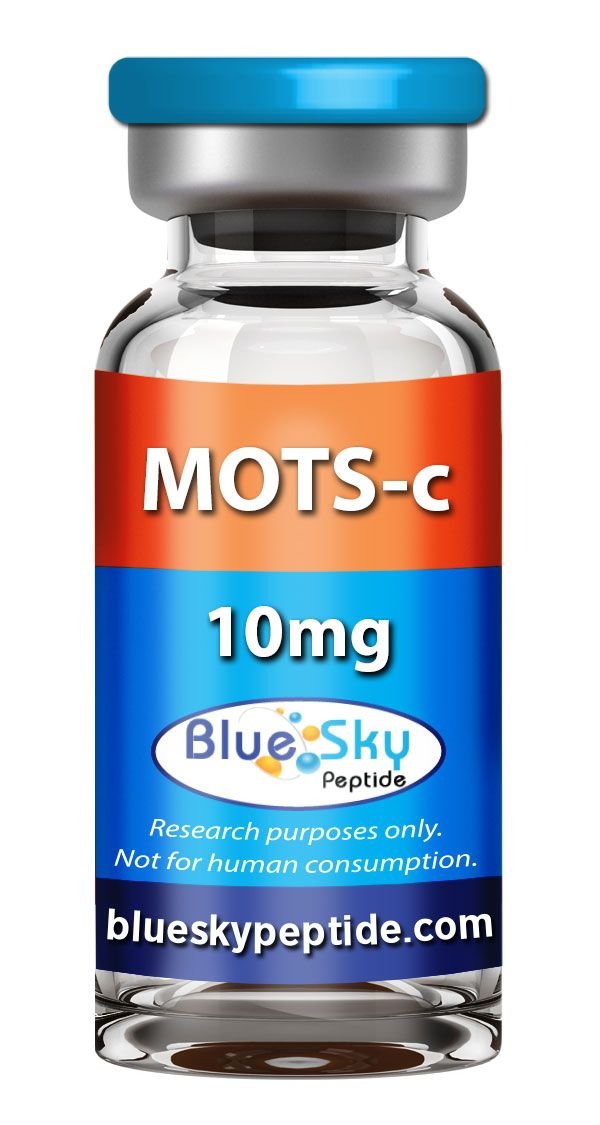
MOTS-c 10mg :
| Unit Size | 10 mg/vial |
| Unit Quantity | 1 vial |
| Purity (Mass Spectrometry and UV) | 99.38% |
| Sequence | Met-Arg-Trp-Gln-Glu-Met-Gly-Tyr-IIe-Phe-Tyr-Pro-Arg-Lys-Leu-Arg |
| Molecular Formula | C101H152N28O22S2 |
| Appearance | Lyophilized White Powder |
| Source | Chemical Synthesis |
| Storage | Lyophilized Mots-C 10mg is stable at room Temperature for 90 days, however it is best to storer in a freeze below – 8c for any extended period of time. |
| Terms | The products we offer are intended for laboratory research use only. Please familiarize yourself with our terms of service prior to ordering. |
MOTS-c 10mg
View Research Overview & References
MOTS-c—short for Mitochondrial ORF of the 12S rRNA Type C—is a 16-amino acid peptide originating from the mitochondrial genome’s 12S rRNA region. As part of the class of mitochondrial-derived peptides (MDPs), it is studied for its role in metabolic and stress-response signaling pathways.1
Animal Model Inflammatory Signaling Research
In animal studies, MOTS-c administration was associated with changes in inflammatory marker levels. In the formalin test, treated mice showed reduced pain-response behavior markers, as indicated by decreased licking time. These effects were associated with activation of the AMPK pathway and inhibition of the MAP kinase/c-Fos pathway in the animal models studied.2-4
Metabolic Signaling Research
Animal studies have examined MOTS-c’s effects on insulin sensitivity and glucose utilization markers, as well as body weight changes.5,6 Research has also examined MOTS-c’s effects on oxidative stress markers and endothelial cell function in animal models.
Mitochondrial Function Research
MOTS-c is studied for its effects on mitochondrial activity and cellular signaling. Research in cellular and animal models has examined MOTS-c’s effects on mitochondrial function markers, cellular stress resistance, and nuclear gene expression through interaction with transcription factors.5
Cardiac Performance Marker Research
Animal studies have examined MOTS-c’s effects on cardiac performance markers during exercise, along with markers of angiogenesis and inflammatory signaling.6
Important Compliance Notice
This product is intended strictly for in vivo (animal) laboratory research. It is not for human or animal consumption, nor is it approved for diagnostic or therapeutic applications. These findings do not establish safety, efficacy, or suitability for any human or animal application. Researchers must adhere to appropriate laboratory protocols when working with MOTS-c.
References
1. Zheng Y, et al. MOTS-c: A promising mitochondrial-derived peptide for therapeutic exploitation. Front Endocrinol. 2023;14:1120533.
2. Lee C, et al. The mitochondrial-derived peptide MOTS-c promotes metabolic homeostasis and reduces obesity. Cell Metab. 2015;21(3):443-454.
3. Yin X, et al. Anti-inflammatory effects of MOTS-c via AMPK activation. Eur J Pharmacol. 2020;870:172909.
4. Yang B, et al. MOTS-c synergizes with exercise to regulate metabolism via AMPK signaling. Biochim Biophys Acta Mol Basis Dis. 2021;1867(6):166126.
5. Kim KH, et al. MOTS-c regulates nuclear gene expression in response to metabolic stress. Cell Metab. 2018;28(3):516-524.e7.
6. Yuan J, et al. MOTS-c improves myocardial performance during exercise training in rats. Sci Rep. 2021;11(1):20077.